
← Science
Adam Savage’s Tested
How Museums Use UV in Conservation
⏱ 22 min video · 2 min read25 May 2026Worth watching
TL;DR
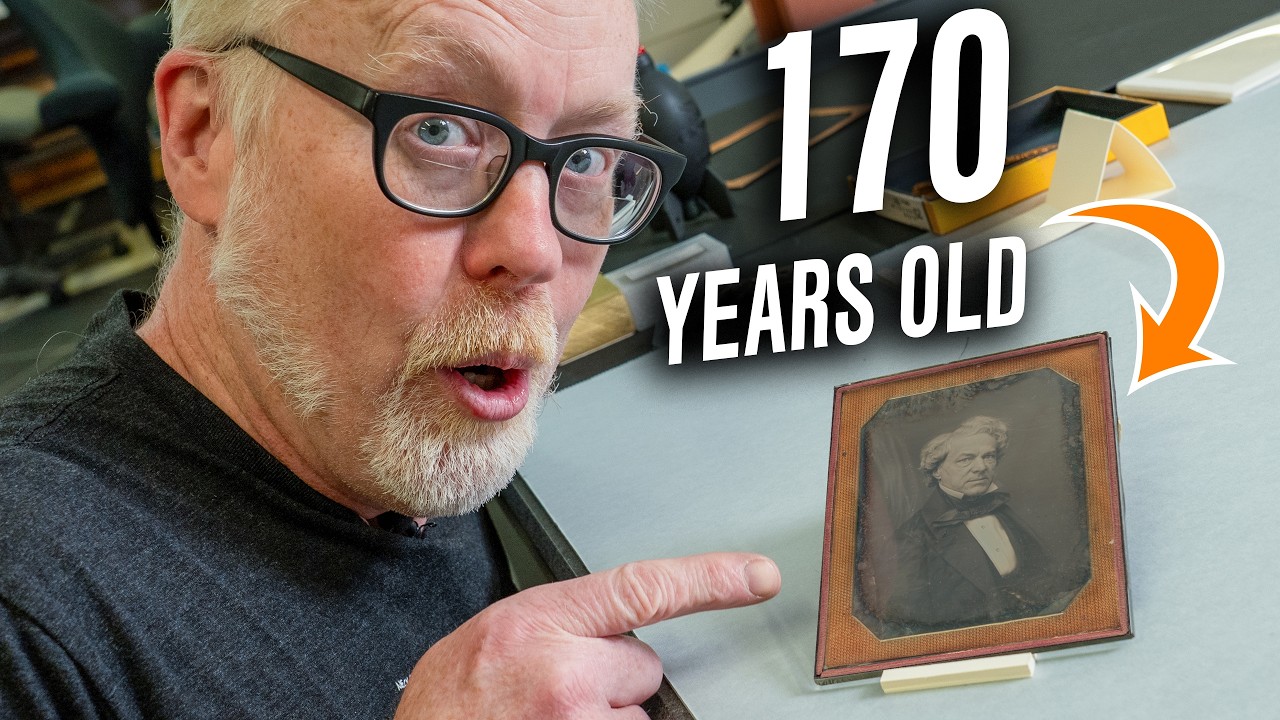
Adam Savage visits the Smithsonian's National Portrait Gallery to watch conservator Anna demonstrate two non-invasive imaging techniques — UV-induced fluorescence and infrared reflectography — used to analyze historic portraits. The video reveals how these tools expose hidden underdrawings, pigment types, past restorations, and artistic decision-making without touching the artwork.
Key points
1
UV-induced visible fluorescence reveals different pigment types (e.g., rose madder lake pigments fluoresce brightly pink), varnish layers from different eras, and degradation patterns in paper-based works like pastels.
2
Infrared reflectography uses a modified full-spectrum DSLR (with the internal IR-blocking blue glass filter removed) to capture carbon-based underdrawings like graphite and charcoal invisible to the naked eye.
3
In the 1948 Gertrude Abercrombie oil painting of James Purdy, IR imaging revealed trees that were sketched but never painted, showing the artist changed her composition mid-process.
4
UV exposure must be strictly limited for works on paper because UV causes chain scission in cellulose polymers, making the material brittle — conservators pre-warm lights and cover the artwork between shots to minimize exposure.
5
Modern clothes contain optical brighteners that glow bright blue under UV, and paper degradation byproducts also fluoresce — both useful diagnostic signals for conservators assessing condition and treatment effects.
Key takeaways
→
A standard DSLR can be converted into a full-spectrum camera by removing the internal blue glass IR-blocking filter over the sensor, enabling infrared photography useful for scientific imaging.
→
When shooting in IR, carbon-based drawing materials (graphite, charcoal) absorb infrared light and appear dark, making underdrawings visible beneath paint layers that would otherwise obscure them.
→
Conservators use a color checker calibrated to RGB 200/200/200 to ensure consistent, comparable exposures across visible light and IR imaging sessions for the same artwork.
Notable quotes
“This is the most intimate time I ever get with any of the works that I treat.”
“Sometimes we don't even do treatment on some objects. We just want to learn more about the artists, and this is one way to do that.”
“A portrait is any painting in which there is something slightly wrong with the mouth.”
Worth watching?
✅
Worth watching the full video?
Watch if you want to actually see the UV and IR imaging happen live on real portraits — the visual before-and-after of the hidden trees and underdrawings is genuinely striking and hard to appreciate from text alone.
Saved you some time? The creator still deserves a like.

Found this by searching? That's the hard way.
summree watches the AI channels you follow and sends you the summary the moment a video drops. Nothing gets past you. From £4/month.
Try it free