← Science
Adam Savage’s Tested
The Ethics of Using a Museum Chair for Spare Parts
⏱ 10 min video · 2 min read27 Jun 2026Worth watching
TL;DR
Adam Savage visits the National Park Service Museum Conservation Labs where conservator Daisy is restoring antique chairs from Harpers Ferry National Historical Park. The key highlight is the rare ethical opportunity to cannibalize a deaccessioned chair from the same collection for spare parts, and the creative problem-solving required to insert spindles without disassembling the chair's bow.
Key points
1
Daisy used parts from a deaccessioned (collection-released) chair to supply missing spindles and a stretcher for two matching chairs from the Free Will Baptist Church at Harpers Ferry National Historical Park — a rare opportunity to source period-accurate materials.
2
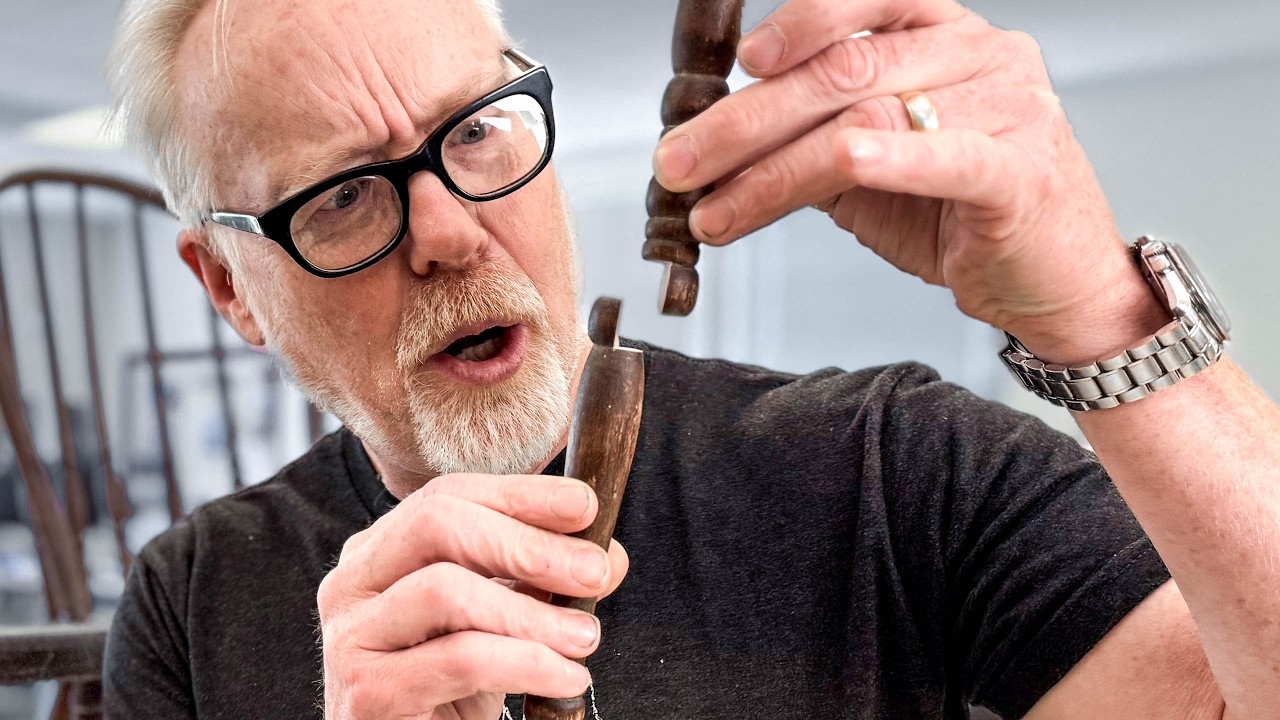
A jeweler saw was used to cut a spindle into a Z-shaped split along the grain, allowing it to be slipped into place between the bow without removing it — an elegant solution born from observing how an original spindle had broken.
3
High-tack fish glue (a protein-based glue) is used because it mirrors the original adhesive, remains water-soluble and reversible, and holds up well over time — loosening with warm water and acetic acid when needed.
4
Deaccessioning museum objects is legally and ethically complex: institutions cannot sell items for profit, must justify removal, and often resort to destroying deaccessioned objects to prevent them from ending up on eBay or misrepresented.
5
The chair restoration involved fully disassembling one chair into dozens of loose parts, refreshing all joints with new glue, and reassembling — a process Daisy described as requiring a creative menagerie of clamps on clamps.
Key takeaways
→
When replicating turned wooden parts without a lathe pattern, map out all bead measurements with calipers before turning rather than relying on a profile template.
→
Fish glue is a preferred conservation adhesive for wooden artifacts: it is protein-based (matching original construction), water-soluble, reversible with warm water or dilute acetic acid, and extremely sticky.
→
When a joint must be inserted without disassembly, study how the original piece failed — a natural break along the grain may reveal a splitting plane that gives maximum glue surface area and reassembles invisibly.
Notable quotes
“How many clamps do you need in the shop? Five more than you currently have.”
“A spindle drilling a hole in one end and another end — they are never ever going to line up.”
“We need a museum of broken things.”
Worth watching?
✅
Worth watching the full video?
Worth watching if you enjoy hands-on conservation or woodworking — seeing the actual chairs and the Z-cut spindle solution up close adds real context, but the key techniques and ethical discussion are fully captured here.
Saved you some time? The creator still deserves a like.

Want this for your own channels?
Add the channels you follow. Every new video summarised and in your inbox the moment it drops. From £4/month.
Try it free