summree
This Completely Changes the Way We Build Production AI Agents (Vercel Eve)
Vercel
Cole Medin

This Completely Changes the Way We Build Production AI Agents (Vercel Eve)

⏱ 16 min video · 3 min read16 Jul 2026Worth watching
TL;DR
Vercel has released Eve, an open-source, file-system-first AI agent framework that lets developers define entire agents as a structured folder of markdown and TypeScript files. It bridges the gap between easy-to-build personal agents and production-grade, scalable deployments with built-in features like durable sessions, sandboxed code execution, human-in-the-loop approvals, and eval-gated deploys.
Key points
1
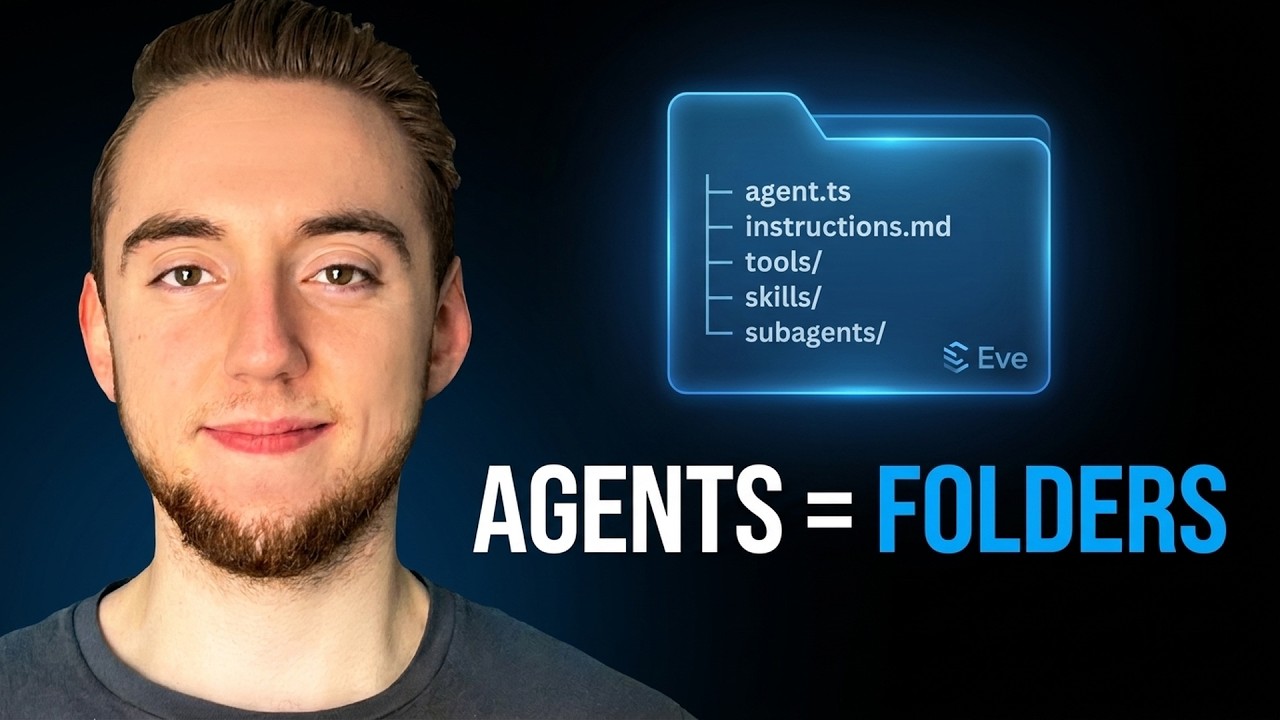
Eve defines an AI agent as a single folder containing subfolders for skills, tools, channels, MCP connections, sub-agents, schedules, sandboxing, and evals — all in markdown and TypeScript with no manual wiring required.
2
A compilation step automatically traverses the folder structure and generates a manifest that hooks everything together, so the core agent.ts file never needs to import or reference individual skills or tools.
3
Production reliability features include durable checkpointed sessions that survive crashes, isolated code sandboxes, human-in-the-loop approval buttons (demonstrated in Slack), and evals as a deploy gate.
4
A Vercel plugin for Claude Code and Cursor ships skills and an MCP server that give coding agents full knowledge of Eve's structure, making it possible to scaffold and deploy a complete agent with a single natural-language prompt.
5
Eve is positioned as a potential open standard for file-system-based agents, comparable to how MCP and A2A standardised other parts of the AI agent stack.
Actionable insights
Install the Vercel plugin for Claude Code or Cursor using the single command linked in the video description — it gives your coding agent the skills to scaffold, build, and deploy Eve agents without you needing to learn the framework deeply.
Use the Eve command locally to run and test your agent incrementally; add skills, tools, sub-agents, and schedules by simply dropping files into their respective folders — no imports or wiring needed.
Set up human-in-the-loop approvals for risky tool calls (e.g. large SQL operations) before deploying to production, and leverage evals as a deploy gate to catch regressions automatically before any update goes live.
Consider pairing Eve (for agent structure) with OKF (for knowledge base structure) when your agent needs to handle large document corpora, as Eve alone does not scale markdown-based knowledge bases to tens of thousands of documents.
Deploy to Vercel to inherit auto-scaling infrastructure capable of handling thousands or millions of concurrent users without additional hosting configuration.
Notable quotes

If you would have told me even half a year ago that agents are coming to this, I would have told you you're crazy. But here we are, and I'm loving it because we're not losing any power of production-grade agents, but it's a lot simpler to get there now.

The biggest reason that this caught my eye in the first place is because I'm seeing a lot of organizations build this kind of thing for themselves internally — and so what Eve gives us here is a standard.

There's no hooking up into the agent here. We just define it as a function in the tools folder, and it's loaded automatically when we compile the agent.

Worth watching?
Worth watching the full video?
Worth watching if you want to see the live demo — the Slack integration, human-in-the-loop approval flow, and one-command scaffold are more convincing in motion — but the summary captures all the architectural detail and key steps you need to evaluate whether Eve fits your stack.
Topics
AI & TechVercel

Explore more summaries on these topics →

Saved you some time? The creator still deserves a like.
Watch on YouTube →
More like this

Found this by searching? That's the hard way.

summree watches the AI channels you follow and sends you the summary the moment a video drops. Nothing gets past you. From £4/month.

Try it free