← Pydantic AI
Cole Medin
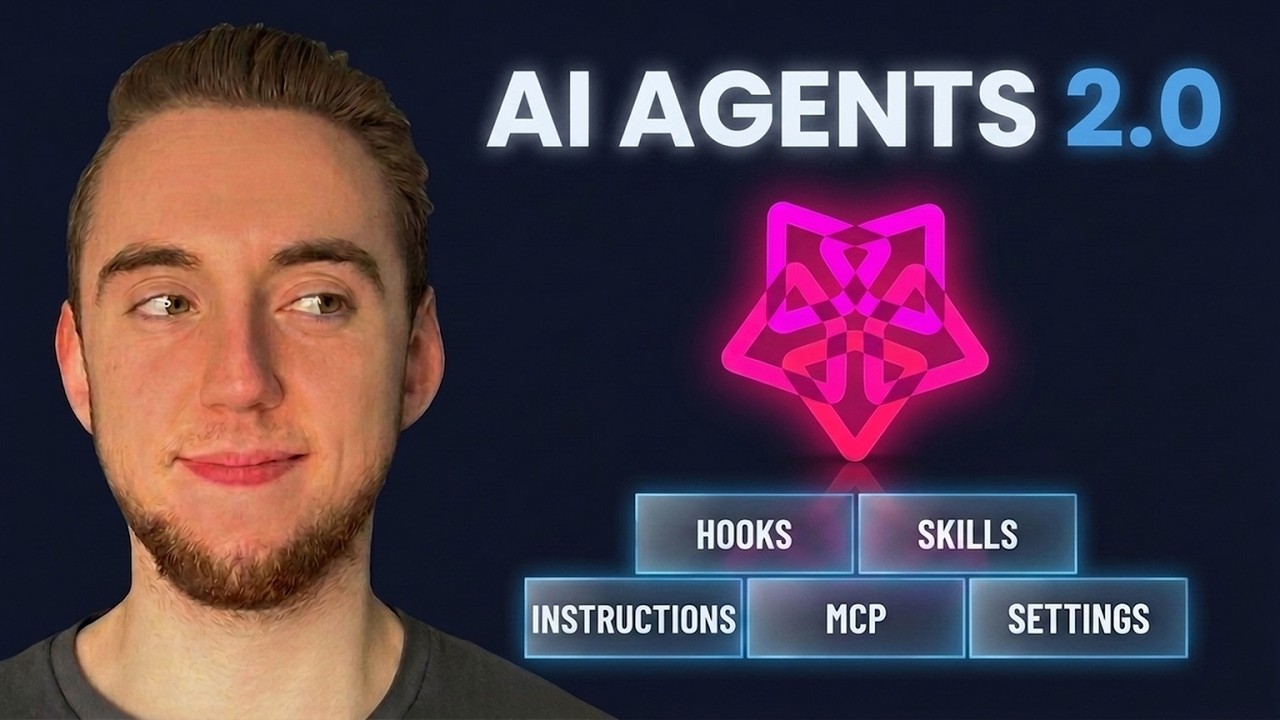
Pydantic AI 2.0: The New Best Way to Build AI Agents is Composing Capabilities
⏱ 15 min video · 3 min read10 Jul 2026Worth watching
TL;DR
Pydantic AI 2.0 introduces a new core primitive called the 'capability' that bundles instructions, tools, hooks, guardrails, and model settings into a single composable, reusable unit. This video explains what capabilities are, how they compare to the 1.0 approach, and why this architectural shift makes Pydantic AI the leading agent framework again.
Key points
1
Pydantic AI 2.0 centers on a single primitive called 'capability' — a composable unit packaging instructions, tools, lifecycle hooks, guardrails, and model settings together.
2
Capabilities enable reuse across agents: e.g. a knowledge-base capability shared between a support agent and an FAQ widget, so improvements benefit both simultaneously.
3
Progressive disclosure lets agents load only the full instructions of capabilities they actually need for a given prompt, keeping token usage and latency low even with dozens of capabilities.
4
The framework has two layers: a lean core (thinking, web search, tool search) imported directly from Pydantic AI, and a harness for less universal capabilities like code execution via their open-source sandbox called Monty.
5
Pydantic AI 1.0 lacked composability — tools and instructions were defined as a hodgepodge with no easy way to extract and reuse subsets across agents.
Actionable insights
→
Use capabilities to modularize your agent: wrap each distinct responsibility (e.g. knowledge base search, escalation) into its own capability so it can be reused and maintained independently across multiple agents.
→
Feed the Pydantic AI capabilities documentation directly to your coding agent (Claude Code, Codex) rather than writing the framework code by hand — the docs are designed for this.
→
Leverage progressive disclosure by giving agents a large catalog of capabilities with brief descriptions; only the ones needed for a given prompt will load full instructions, keeping costs and latency down.
Notable quotes
“I really don't think you should be writing the Pydantic AI agent code by hand anymore. I've not done it for over a year now. Please don't spend your time on that.”
“It's a simplification without reducing how powerful our agents can be with Pydantic AI.”
“When you want to deploy an agent to production and you have other people using your agent, you can't just lean on those coding agent SDKs — you need a framework. Pydantic AI really is my go-to.”
Worth watching?
✅
Worth watching the full video?
Worth watching if you build production AI agents with Pydantic AI or are choosing between agent frameworks — the live code walkthrough and demo of progressive capability loading make the architectural concepts much clearer than reading docs alone.
Saved you some time? The creator still deserves a like.

Found this by searching? That's the hard way.
summree watches the AI channels you follow and sends you the summary the moment a video drops. Nothing gets past you. From £4/month.
Try it free