← Claude Code
AI Jason
I was giving my coding agent context the wrong way...
⏱ 9 min video · 2 min read30 Jun 2026Worth watching
TL;DR
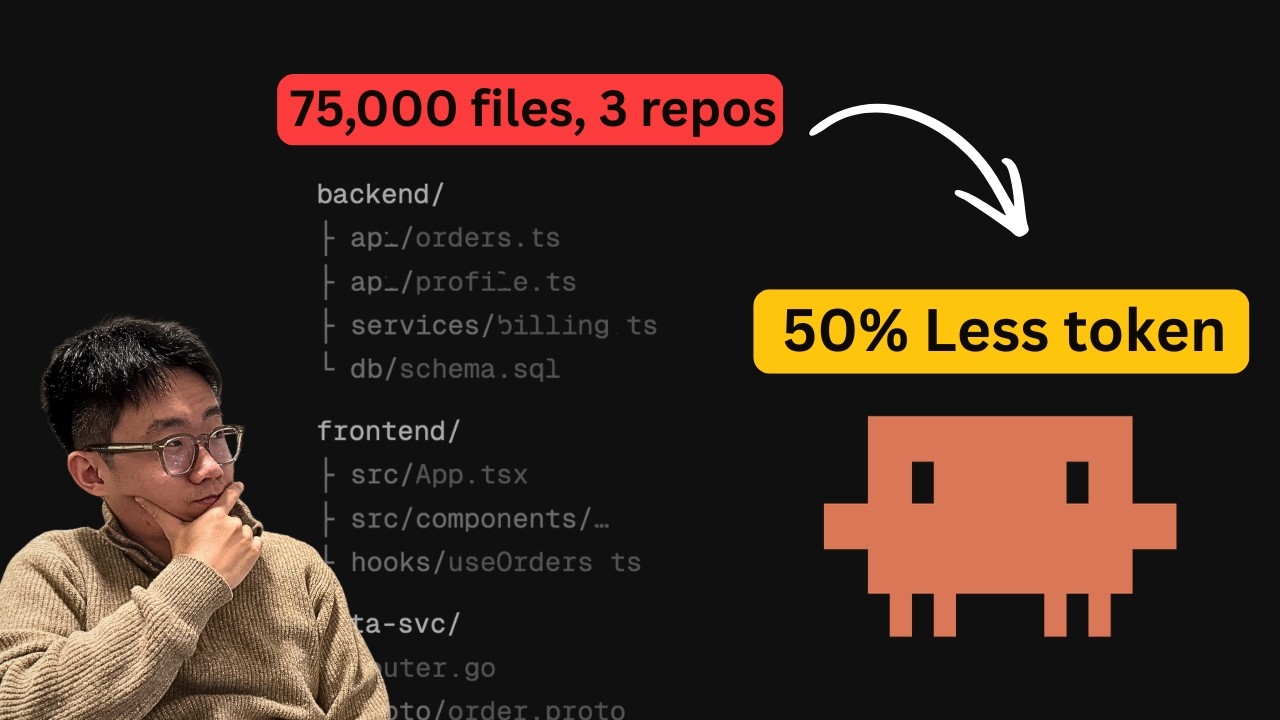
The creator introduces 'Codebase Memory MCP', a C/C++-built tool that converts a codebase into a relationship graph so coding agents like Claude Code navigate dependencies intelligently instead of brute-force reading files. The result is nearly 50% fewer tokens consumed and faster, more accurate code change analysis.
Key points
1
Codebase Memory MCP builds a programmatic relationship graph (functions, classes, imports) without any LLM pipeline, making indexing near-instant even for large repos like the Linux kernel (under 3 minutes).
2
Token consumption dropped from ~38,000 to ~11,000 for the first query and ~64,000 to ~33,000 for the second in a direct comparison test on the same codebase.
3
A pre-tool-use hook intercepts normal grep/ripgrep searches and automatically appends graph-enriched context, so agents benefit even when they forget to call the MCP tool explicitly.
4
Key agent tools provided: get_architecture, search_graph, trace_path, graph query, get_code_snippet, and detect_change for PR impact analysis.
5
The creator has integrated this MCP into his open-source 'setup codebase' skill (GitHub: AI Builder Club), which also sets up end-to-end tests, a local server toolkit, and parallel agent sandboxing.
Actionable insights
→
Install Codebase Memory MCP with the --ui flag to get a visual graph explorer alongside the agent tooling; indexing runs in seconds for typical projects.
→
Use the pre-tool-use hook pattern when building any MCP tool so agents gain graph-enriched results even when they default to standard grep searches.
→
Run 'trace_path' before making changes to hidden or layered logic (e.g., lock mechanisms) to surface all 13+ call sites and avoid unintended breakage.
→
For monorepos or multi-repo projects, the cross-repository graph makes cross-service dependency tracing possible without manually chasing imports.
→
Search the GitHub repo 'AI Builder Club' to grab the pre-built setup skill that bundles this MCP with other best-practice tooling for new-loop engineering.
Notable quotes
“Your codebase is already a map. Every import, every function call is an edge. Your agent just throws that structure away and reads it as flat text.”
“This canvas lock thing is actually very hidden... for any agent or even human reading this one file, this protection is real but just invisible from where the work starts.”
“It didn't really rely on agent to always call this special MCP tool — and I think this is a much better design pattern than most of the MCP tools.”
Worth watching?
✅
Worth watching the full video?
Watch if you use Claude Code or any coding agent on real codebases — the live token comparison demo alone makes the efficiency gains concrete, and the setup walkthrough is quick enough to replicate immediately.
Saved you some time? The creator still deserves a like.


Want this for your own channels?
Add the channels you follow. Every new video summarised and in your inbox the moment it drops. From £4/month.
Try it free