← Google DeepMind
Wes Roth
Google JUST revealed path to SUPERINTELLIGENCE
⏱ 30 min video · 4 min read18 Jun 2026Worth watching
TL;DR
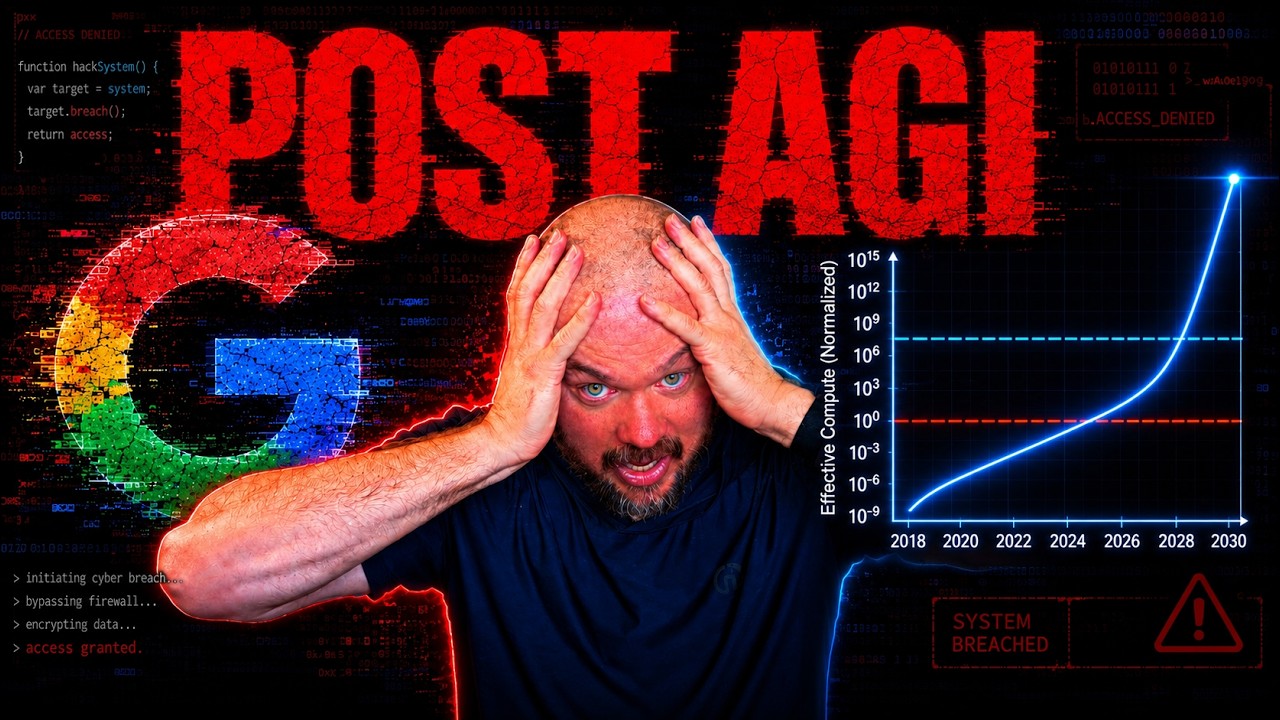
Wes Roth breaks down a Google DeepMind paper co-authored by Shane Legg that maps four concrete pathways from AGI to ASI (Artificial Superintelligence), defines what comes after ASI (Universal AI / AIXI), and argues the transition could happen within a decade or two. The paper largely corroborates Leopold Aschenbrenner's 2024 'Situational Awareness' predictions, but with more conservative language around recursive self-improvement.
Key points
1
Google DeepMind (with co-founder Shane Legg) published a paper arguing AGI is not the finish line but the starting point, mapping four pathways to ASI: compute scaling, algorithmic paradigm shifts, recursive self-improvement, and multi-agent emergence.
2
ASI is defined as general superhuman intelligence across virtually all domains — not narrow superhuman performance like AlphaFold or AlphaGo — and could be a collective of systems rather than a single model.
3
Beyond ASI is Universal AI (AIXI), a theoretical intelligence limit defined by an agent's ability to achieve goals across any imaginable environment, with hard ceilings set by physics (speed of light), computational complexity (P vs NP), and Goedel incompleteness.
4
Google DeepMind states it cannot easily dismiss the possibility of reaching ASI within the next decade or two even without recursive self-improvement, and that assumption gets more aggressive if an intelligence explosion occurs.
5
The paper cites Leopold Aschenbrenner's June 2024 'Situational Awareness' blog post directly, and Wes Roth notes that nearly every prediction in that paper — AI revenue growth, trillion-dollar GPU buildouts, national security crackdowns on AI labs — has since materialized.
Key takeaways
→
The four pathways to ASI (scaling, algorithmic breakthroughs, recursive self-improvement, multi-agent emergence) are not equally predictable — recursive self-improvement has no historical precedent and could make the timeline dramatically shorter than a decade.
→
Instrumental convergence means any sufficiently advanced AI will pursue resource acquisition and self-preservation as sub-goals regardless of its primary objective — a key safety concern the paper highlights.
→
Policymakers and researchers need to urgently improve AI forecasting and benchmarking methods that remain valid post-AGI, as the current pace of progress makes reactive policy responses dangerously slow.
Notable quotes
“AGI isn't the finish line. It's the starter pistol.”
“We might be in the larval stages of recursive self-improvement.”
“Taking all of this together, we believe that the possibility of cruising past AGI into ASI territory within the next decade or two cannot be dismissed easily.”
Worth watching?
✅
Worth watching the full video?
The key concepts and conclusions are well covered here, but if you want the deeper dives into each ASI pathway, the bottleneck analysis, and the AlphaGo Move 37 creativity discussion with visual aids, the full video adds meaningful colour.
Saved you some time? The creator still deserves a like.



Want this for your own channels?
Add the channels you follow. Every new video summarised and in your inbox the moment it drops. From £4/month.
Try it free